Publications

Displaying 381 - 390 of 1085
This paper presents some of the challenges of the leaving no-one behind mandate. Firstly, how the development cooperation system can be brought up to date; secondly, why cooperation may still be useful and effective in supporting an Agenda beyond ODA; and finally, the way in which resources should be allocated in order to preserve the purpose of development cooperation.
Angola Equatorial Guinea Equatorial Guinea's letter to OHRLLS Maldives Samoa Samoa’s smooth transition strategy report
Bhutan Kiribati Note by UNSD on the treatment of fishing licenses Nepal São Tomé and Príncipe Solomon Islands
Bhutan (including Bhutan's response to the impact assessment and DESA's reply) Kiribati Nepal (including Nepal's response to the impact assessment) São Tomé and Príncipe
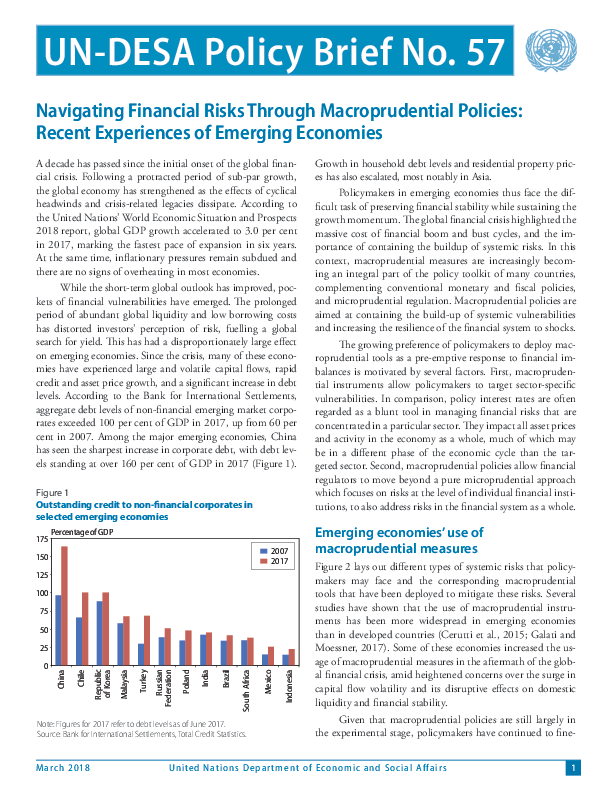
A decade has passed since the initial onset of the global financial crisis. Following a protracted period of sub-par growth, the global economy has strengthened as the effects of cyclical headwinds and crisis-related legacies dissipate.
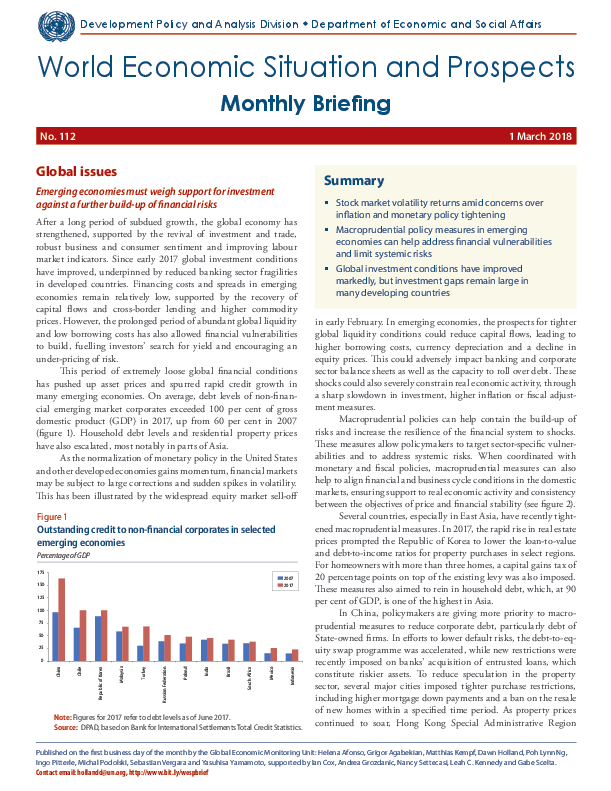
Stock market volatility returns amid concerns over inflation and monetary policy tightening
Macroprudential policy measures in emerging economies can help address financial vulnerabilities and limit systemic risks
Global investment conditions have improved markedly, but investment gaps remain large in many developing countries
The CDP subgroup met in New York City from 1 - 2 February 2018 to review the data used for the identification of least developed countries (LDCs)
Strengthened intellectual property requirements, government procurement, dispute settlement constrain policy space for implementing universal health coverage. These consequences can have particularly dramatic effects for countries that made effective use of medicines and intellectual property policies to expand access to medicines.
Least developed countries (LDCs) are characterized by limited productive capacities, which constrains their efforts towards structural transformation and sustainable development. At the same time, the actual policy choices countries that have graduated or have made significant progress towards graduation from the LDC category provide a wide range of lessons other LDCs and the international community can learn from. Whereas countries can be on different pathways towards graduation, a diverse set of social, macroeconomic, financial, agricultural and industrial policies can be effective. However, good development governance is the key factor for successfully expanding productive capacity.