 Welcome to the United Nations

Rising investment in digital transformation
Unprecedented developments in digital technologies and innovation over recent decades continue to reshape economies, societies, and livelihoods. The digital transformation is driven by the convergence and widespread adoption of advanced technologies, with a key enabler being information and communications technologies (ICT).
The ICT sector has been a leading force in technological innovation and plays a vital role in driving advancements in other industries (World Bank, 2024). Investments in the ICT sector have risen sharply, particularly in areas such as computer software and database management which saw significant growth after 2020 (figure 1). The sector’s share in gross fixed capital formation has increased significantly in developed economies, exceeding 12 per cent since 2020. Developing countries saw a rise in investment in the ICT sector, as well. For example, in Brazil, investment in the ICT sector reached 2.7 per cent of GDP. This surge was largely catalysed by the COVID-19 pandemic, which compelled private and public entities around the world to rapidly adopt remote work, digital collaboration tools, and e-commerce platforms to continue operations.
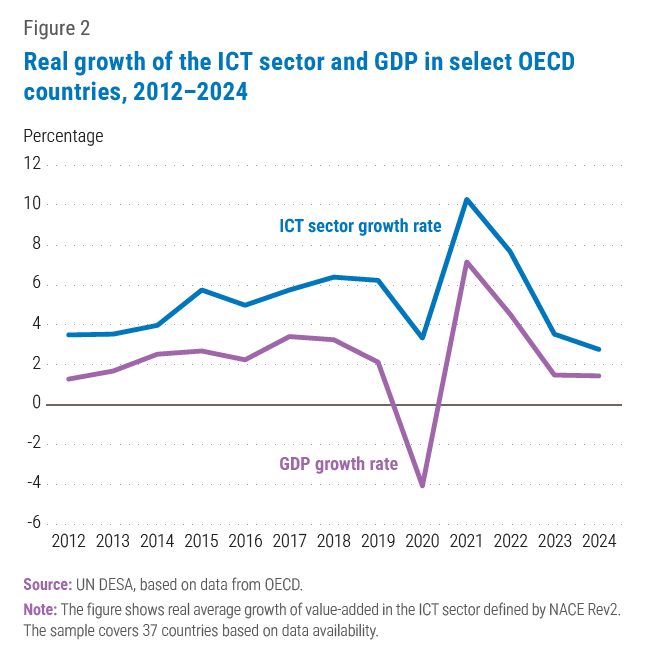
Reflecting these investments, the ICT sector’s contribution to GDP and employment has also increased in developed countries. Between 2011 and 2024, the sector outpaced overall economic growth, averaging an annual value-added growth rate of approximately 5 per cent—more than double the rate of the total economy (figure 2). The global ICT market was valued at an estimated $5.5 trillion in 2024 and is projected to grow at a compound annual growth rate (CAGR) of 5.2 per cent through 2031. While the United States accounts for the largest share of today’s market (about 40 per cent), growth is projected to be strongly driven by countries in Asia and the Pacific.

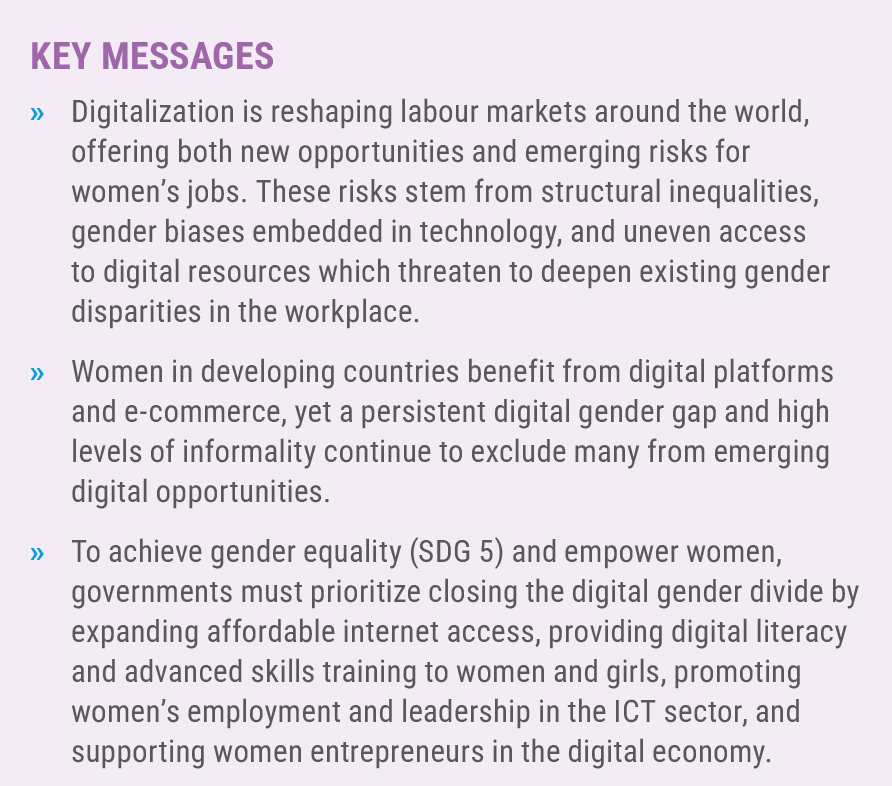
The rapid expansion of the ICT sector and the broader digital economy offers a powerful opportunity to advance sustainable development across multiple dimensions, including gender equality (SDG 5) and decent work for all (SDG 8). Digital transformation is reshaping women’s employment through new work models like remote work, teleworking, and the gig economy, which can allow for working around traditional barriers such as rigid schedules, caregiving responsibilities, social norms, and geographic limitations. By enabling more flexible and innovative employment options, digitalization can drive greater economic inclusion and empowerment for women. Importantly, closing the gender digital divide is not only a matter of fairness but also an economic imperative: it could boost global GDP by $1.5 trillion and lift 30 million women and girls out of poverty by 2030 (UN Women, 2025). These substantial benefits highlight why targeted policies to ensure equal access to digital tools, skills, and opportunities are essential for creating a more inclusive and prosperous digital economy.
Employment growth and gender gaps in the ICT sector
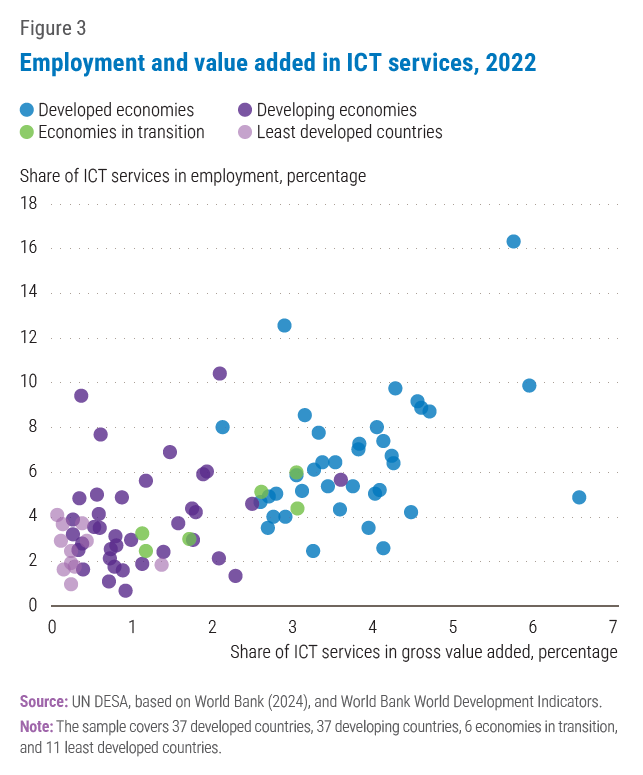
The expansion of the ICT sector is driving employment growth and generating new job opportunities. From 2000 to 2022, global employment in the ICT sector nearly doubled, reaching 68 million jobs and raising the sector’s share of total global employment to 2 per cent from 1.3 per cent (World Bank, 2024). China led this growth, creating 13 million jobs, followed by India and the United States. Most of these jobs were created in the ICT services subsector, reflecting a shift in value added from traditional hardware manufacturing and telecommunications to more advanced services such as software development and artificial intelligence (AI). Economies with a more developed ICT sector, reflected in a larger share of ICT in gross value added, tend to also have a higher proportion of employment in ICT services (figure 3). In some developing countries, including Malaysia, Nigeria, and Viet Nam, ICT services employment is growing, but gross value added may lag due to concentration in lower value-added activities such as hardware assembly, call centers and data entry.
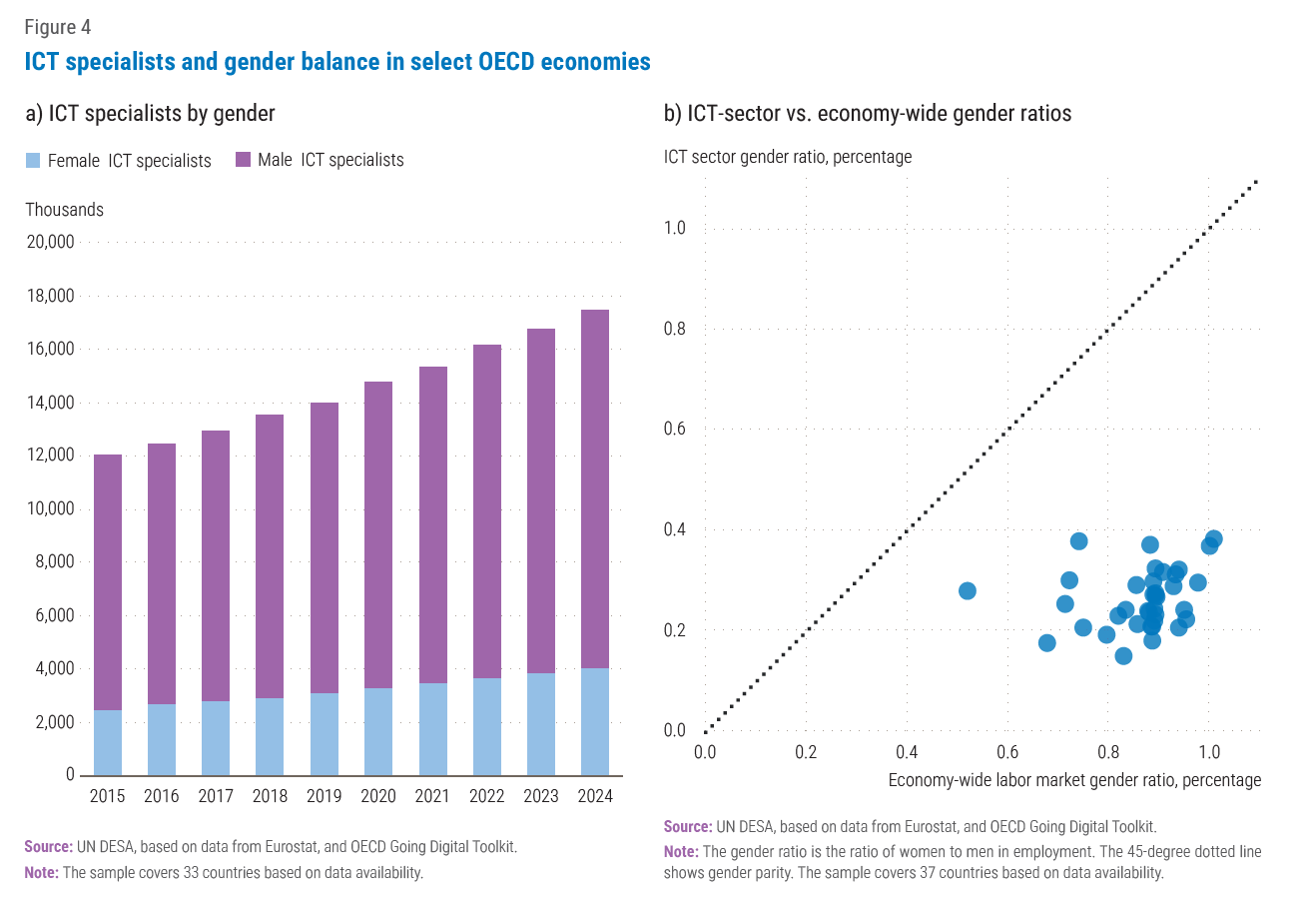
 However, while the ICT sector presents important opportunities for employment and innovation, it also risks reinforcing existing gender inequalities. Women have benefited from the increased demand for tech workers, but their employment as ICT specialists remains disproportionately low. The number of ICT specialists in Organisation of Economic Co-operation and Development (OECD) economies has increased by nearly 45 per cent since 2015 (figure 4a). During this time, the number of women ICT specialists rose by more than 50 per cent. Yet, their overall share increased only modestly—from 20 per cent to 23 per cent—highlighting persistent gender imbalances as most new ICT specialist positions continue to be filled by men. Even in developed countries and upper-middle-income developing countries—where gender gaps have narrowed in many fields—the disparity in the ICT sector remains particularly pronounced (figure 4b).
Opportunities beyond the ICT sector
The labour market benefits of digitalization extend far beyond creating jobs within the ICT sector. Digital technologies are opening new pathways and tools that reshape production, business operations, and work models in ways that can significantly empower women economically and socially. Digitalization of tasks creates new employment opportunities in sectors like digital health (HealthTech), educational technology (EdTech), and digital finance. In many sectors where women are traditionally highly represented—such as agriculture, low-skill manufacturing, retail, and services—digital technologies are helping to reduce barriers and improve productivity. For example, in retail and artisanal crafts, online marketplaces enable women entrepreneurs to reach national and global customers, expanding their businesses beyond local constraints. UN Women’s Digital Inclusion for Women’s Economic Empowerment (D4WEE) project in Liberia connected over 2500 women farmers to broader markets through the ‘Buy from Women’ platform, enabling them to increase their income by improving market access.
Moreover, digitalization facilitates flexible and accessible income opportunities through remote work, teleworking, and platform economies, which are particularly valuable for women balancing work with caregiving and household responsibilities. Globally, women spend 2.5 times as many hours on domestic and care work as men. In Northern Africa and Western Asia, this disparity rises to 4 times (UN Women, 2025). This unequal burden of caregiving responsibility keeps an estimated 708 million women outside the labour force, including 397 million prime-aged (aged 25–54) women in 2023. Digital technologies offer new avenues for women to pursue economically remunerative work despite care responsibilities. Recent studies indicate that adoption of remote work and digital freelancing increased the likelihood of women participating in the labour force by 26 percentage points compared to when remote work is not an option in BRICS countries (Brazil, China, India, Russian Federation, and South Africa) and by 24 percentage points in Mexico (Shuangshuang et al., 2023; Inchauste and Siravegna, 2024).
Digital financial services and mobile money platforms also support women’s economic empowerment by enhancing access to credit, savings, and insurance products, which have traditionally been difficult for women to obtain due to lack of collateral or formal documentation. In the Philippines, digital bank Maya uses payment histories to build alternative credit scores, significantly expanding credit access for women (OECD, 2025). Mobile money platforms increased women’s access to credit from formal financial institutions by 23 per cent in 78 developing countries (Agarwal and Assenova, 2024).
Risks and challenges to women’s work
While digitalization and the rise of the digital economy present new opportunities for employment growth and inclusion, they also bring significant risks and challenges. These risks affect both women and men, but their impacts are experienced differently due to existing social, economic and cultural factors.
Job displacement is one of the primary challenges. Earlier stages of digitalization introduced automation technologies which affected primarily routine, manual, and low-skill tasks. These tasks are disproportionately occupied by women, especially in sectors such as manufacturing, administrative support, and clerical work. While these advancements increased productivity, they also resulted in job displacements in these sectors. Between 2000 and 2019, a total of 3.5 million administrative support and assembly-line jobs were lost among prime-age women in the United States, compared to 1 million men. But, AI, particularly generative AI (GenAI) increasingly automates tasks across various skill levels and is expected to have more wide-ranging effects.
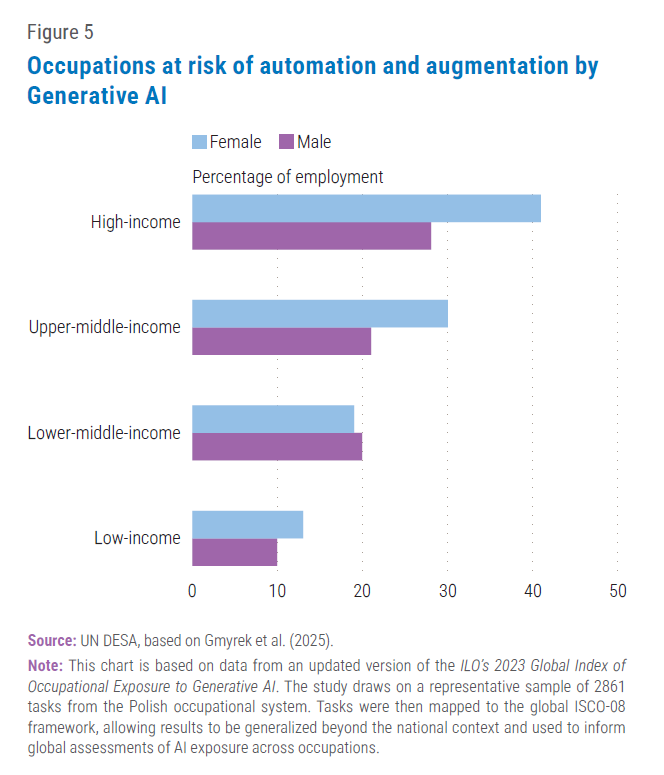 Globally, 27.6 per cent of jobs occupied by women are potentially exposed to GenAI, compared to 21.1 per cent of jobs held by men (UN Women, 2025). The potential employment effects—whether through automation or augmentation of tasks—vary widely across countries (Gmyrek et al., 2025). Women in high-income and upper-middle income countries face a particularly strong exposure to GenAI due to their concentration in clerical jobs, education, and public administration (figure 5). In contrast, gender disparities are narrower in lower-income countries, largely because women are underrepresented in occupations most affected by these technologies.
Underrepresentation of women in technology is another critical challenge that limits women’s participation in designing and benefiting from these technologies. This persistent gap is concerning not only for women’s current status in the field, but also for the future: AI systems trained on biased datasets risk perpetuating and amplifying discrimination in hiring processes and other critical decisions (Awad et al., 2025). While greater representation in tech does not automatically eliminate the bias in AI systems, more diverse teams are better positioned to identify and mitigate the risks posed by biased datasets.
Women’s low representation in science, technology, engineering and mathematics (STEM) graduates and jobs can significantly intensify gender inequalities amid digital transformation. As economies increasingly rely on digital technologies, STEM skills become essential for accessing technology jobs and shaping the direction of innovation. While the share of women with skills in STEM fields has risen in recent years, it remains persistently low—below one third across a sample of 73 countries (World Economic Forum, 2024). Various initiatives are working to address this gap: the European Union’s ‘Women in Digital’ and Rwanda’s ‘Girls in ICT Rwanda’ aim at equipping women with the digital skills required to benefit from emerging digital economies. In Indonesia, the ‘Strengthening Communities/Improving Lives and Livelihoods (SCILLS)’ program focuses on digital literacy, especially among rural women, to bridge gaps in access and skills (Lbouhmadi, 2025).
Digital platform work often operates outside conventional employment frameworks, resulting in job insecurity, low pay, and inadequate protections against harassment—issues that disproportionately affect women (UN Women, 2021). Female ride-share drivers and delivery workers, for instance, frequently report safety concerns and face discriminatory customer ratings that directly impact their earnings and ability to continue working (ILO, 2022). The lack of regulation in these rapidly growing sectors leaves women workers particularly vulnerable, with limited recourse when facing unsafe conditions or discrimination.
Gendered unpaid care work may be reinforced by remote work and working from home arrangements. The shift to remote work and digital platforms may blur boundaries between paid work and domestic responsibilities, with women more likely to absorb increased caregiving and household tasks. Without supportive policies, this double burden of income-generating work and unpaid care work can undermine women’s productivity and career progression, perpetuating gender inequalities in labour markets (Chen et al., 2025).
Impacts on women’s work in developing economies
The informal sector is a critical source of women’s employment in developing countries. In 2024, an estimated 94.0 per cent of women in least developed countries (LDCs) and 91.4 per cent in sub-Saharan Africa were engaged in informal work, compared to 86.4 per cent and 86.0 per cent of men, respectively (UN DESA, 2025).
Digital technologies have enabled women in informal work relations to bypass traditional barriers to access formal employment such as mobility restrictions, capital and market access. Mobile phones and internet platforms have allowed women in rural areas to engage in e-commerce, freelance work, and digital marketing. Similarly, digital marketplaces and social media platforms enable women artisans and small businesses to reach wider audiences (de Silva, 2022).
However, the benefits of digitalization are not evenly distributed. A persistent digital gender gap driven by unequal access to devices, poor internet connectivity, and limited digital literacy constrains women’s ability to participate in emerging digital economies such as e-commerce, remote work, and online freelance platforms. In low- and middle-income countries, women are 7 per cent less likely to own a mobile phone than men, and 15 per cent less likely to use mobile internet (World Bank, 2023). This disparity reaches above 35 per cent in sub-Saharan Africa and South Asia.
Many women in developing countries, such as India and Nigeria, have turned to platform work including ride-sharing, online tutoring, and digital content creation (ILO, 2021a). However, without formal contracts and sector regulation, these working arrangements can push women deeper into precariousness and exacerbate existing vulnerabilities.
In many developing countries, the manufacturing sector employs a large proportion of women, particularly in textiles, garments, and electronics assembly. Automation and advanced manufacturing technologies threaten to displace low-skilled jobs in this sector. For example, research in Bangladesh and Viet Nam shows that automation in garment factories risks replacing routine manual tasks primarily performed by women, potentially causing significant job losses if adequate reskilling opportunities are not provided (ILO, 2021b). Conversely, evidence from China suggests that manufacturing digitalization not only increased female employment but also narrowed the gender wage gap (Wu et al., 2024). These contrasting outcomes show that while digitalization poses risks, it can also create pathways for upskilling, enabling women to move into higher-value roles such as machine operation, quality control and supply chain management—provided appropriate training and support are available.
Policy implications for advancing gender equality in labour markets
Digital technologies can expand access to jobs, enable flexible work arrangements, and foster entrepreneurship. However, unequal access to digital tools and skills, gender biases embedded in technology, and women’s underrepresentation in STEM and the ICT sector threaten to exacerbate existing gender disparities. The rapid adoption of AI adds a new layer of complexity: without diverse perspectives in AI development and oversight, algorithms risk replicating and amplifying systemic biases, particularly in hiring processes, credit access, and public services. Without targeted policy interventions, digital transformation risks reinforcing patterns of exclusion and limiting women’s economic participation.
Governments should therefore prioritize policies that bridge the digital gender divide. First, expanding affordable internet access and digital infrastructure is critical, particularly in underserved areas. Second, digital literacy and advanced digital skills training programmes tailored to women and girls should be made widely available. Third, women’s increasing participation in the tech workforce requires systemic change through inclusive recruitment practices, workplace policies that address bias, and leadership development programs.
Support for women entrepreneurs in the digital economy demands equal attention. This includes improving access to finance, providing business development services, and establishing mentoring networks. As platform work expands, labour protections and social security systems must evolve accordingly—ensuring fair wages, safe working conditions and access to social protection for all workers.
Finally, as AI becomes central to how economies and labour markets function, it is essential to ensure that women are not only users of AI technologies but also play a key role in its design and implementation. By integrating gender equality into digital and AI policy frameworks, governments can move beyond just inclusion to ensure that women shape and lead the digital economy’s future.