Displaying 11 - 20 of 33
This paper provides an overview of the conceptual and empirical issues involved in the overarching goal of "leaving no one behind" (LNOB). It proposes ways to operationalize LNOB, discusses whether to take a country-focused or person-focused approach, examines various (multidimensional) ways to measure those who are left behind, argues for grounding LNOB on intrinsic and instrumental reasons, suggests ways to identify those at risk of being left behind, and discusses difficult trade-offs with other SDGs for an agenda focused on LNOB.
One of the pillars of the 2030 Agenda for Sustainable Development is the pledge to ?leave no one behind?. This paper argues that we must recognise that many people throughout the world are not just being left behind. They are being pushed even further behind, and their levels of well-being are falling, often in ways from which it is impossible to fully recover.
The UN Resolution heralding the Sustainable Development Goals pledges to leave no one behind, and moreover "to reach the furthest behind first". This priority echoes the priority to the worst-off that is being discussed in philosophy, economics and related disciplines, but also the pleas of many actors who represent or fight for the most disadvantaged populations. This paper argues that serious theories do support such a priority and that the best policies implementing this priority do not necessarily involve the most intuitive anti-poverty targeted measures.
The paper focuses on two crucial issues that hinder the fiscal sovereignty of developing countries: the reduced level of international tax cooperation, and the lack of appropriate procedures for sovereign debt crisis resolution. The low level of international tax cooperation enables a race to the bottom in tax rates among countries, tax avoidance through profit-shifting activities by companies and tax evasion by individuals and companies, based on the existence of non-cooperative jurisdictions.
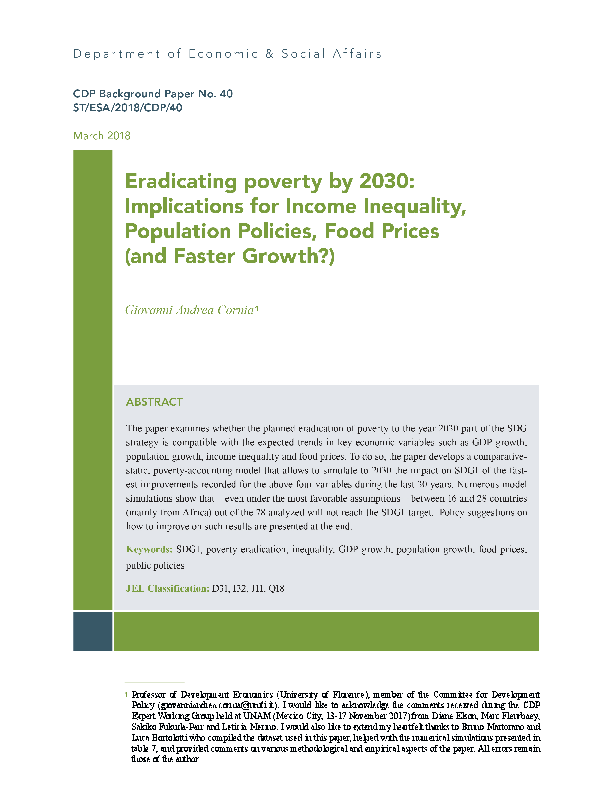
The paper examines whether the planned eradication of poverty to the year 2030 part of the SDG strategy is compatible with the expected trends in key economic variables such as GDP growth, population growth, income inequality and food prices.
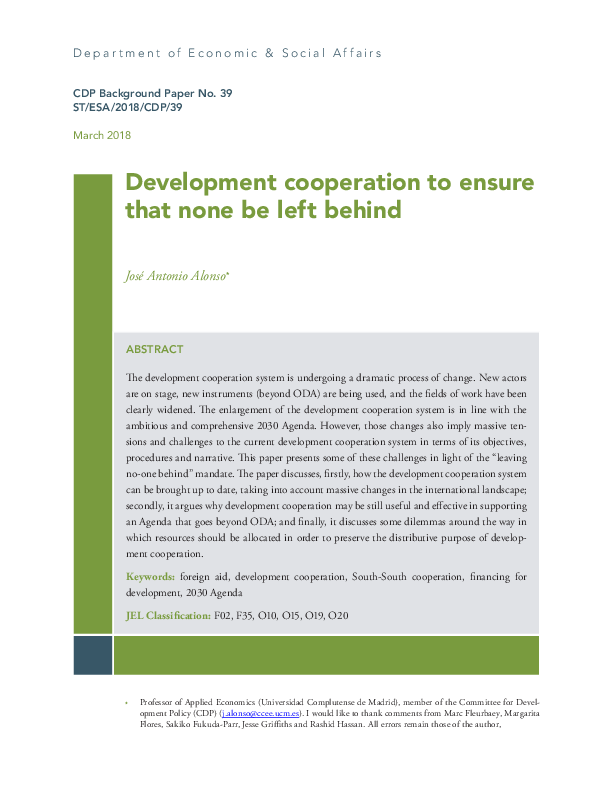
This paper presents some of the challenges of the leaving no-one behind mandate. Firstly, how the development cooperation system can be brought up to date; secondly, why cooperation may still be useful and effective in supporting an Agenda beyond ODA; and finally, the way in which resources should be allocated in order to preserve the purpose of development cooperation.
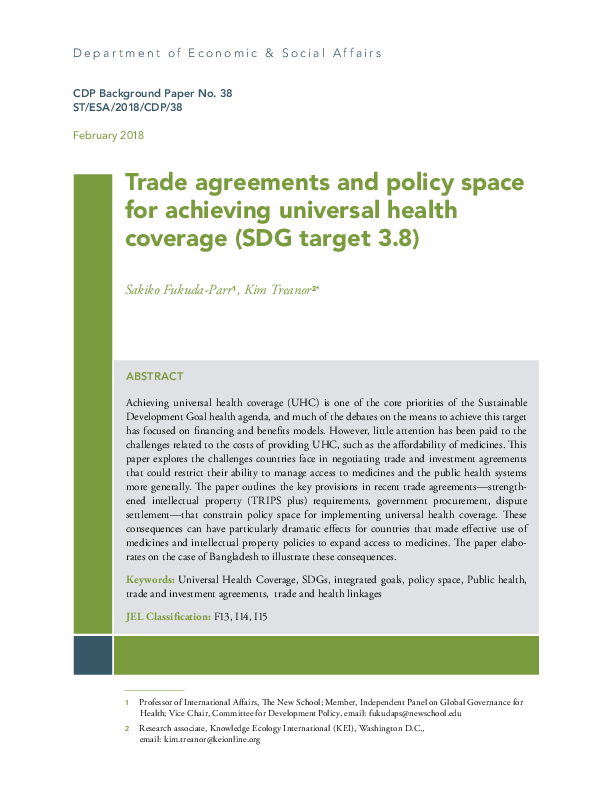
Strengthened intellectual property requirements, government procurement, dispute settlement constrain policy space for implementing universal health coverage. These consequences can have particularly dramatic effects for countries that made effective use of medicines and intellectual property policies to expand access to medicines.
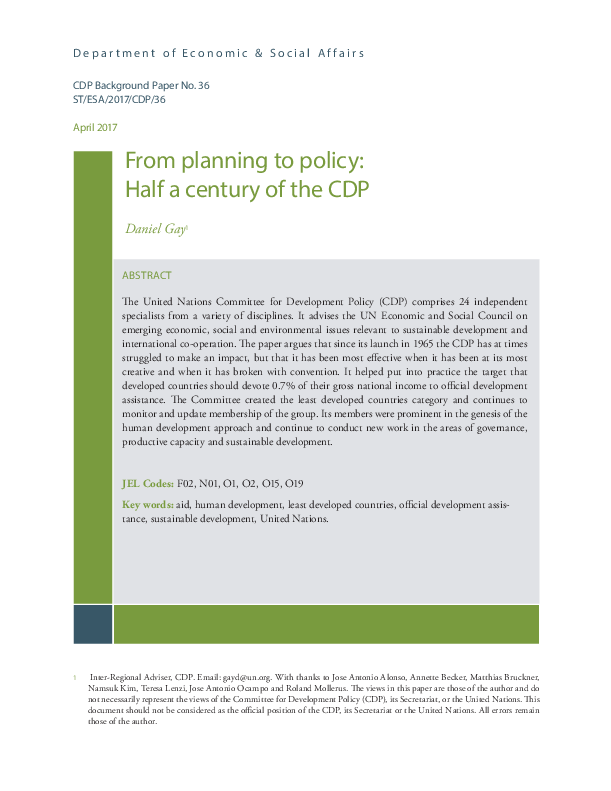
The United Nations Committee for Development Policy (CDP) comprises 24 independent specialists from a variety of disciplines. It advises the UN Economic and Social Council on emerging economic, social and environmental issues relevant to sustainable development and international co-operation. The paper argues that since its launch in 1965 the CDP has at times struggled to make an impact, but that it has been most effective when it has been at its most creative and when it has broken with convention.
The CDP helped put into practice the target that developed countries should devote 0.7% of their gross national income to official development assistance. The Committee created the least…
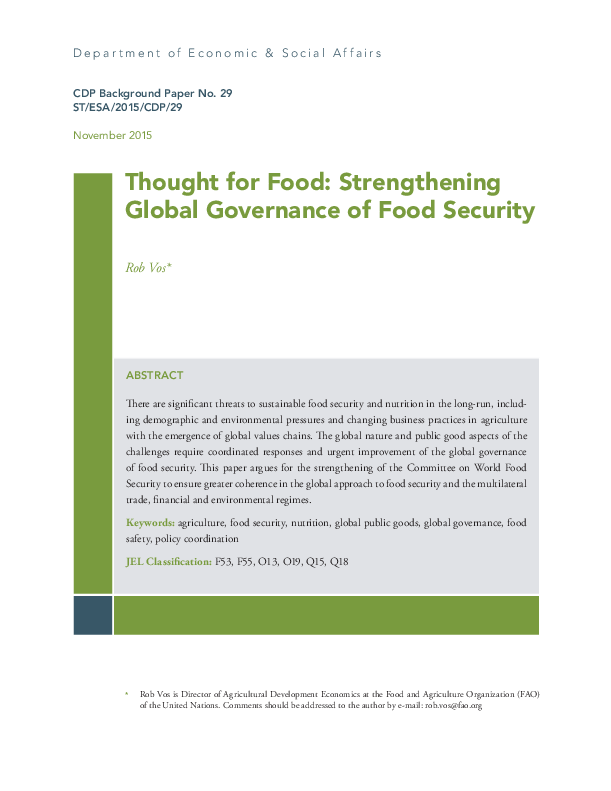
There are significant threats to sustainable food security and nutrition in the long-run, including demographic and environmental pressures and changing business practices in agriculture with the emergence of global values chains. The global nature and public good aspects of the challenges require coordinated responses and urgent improvement of the global governance of food security. This paper argues for the strengthening of the Committee on World Food Security to ensure greater coherence in the global approach to food security and the multilateral trade, financial and environmental regimes.
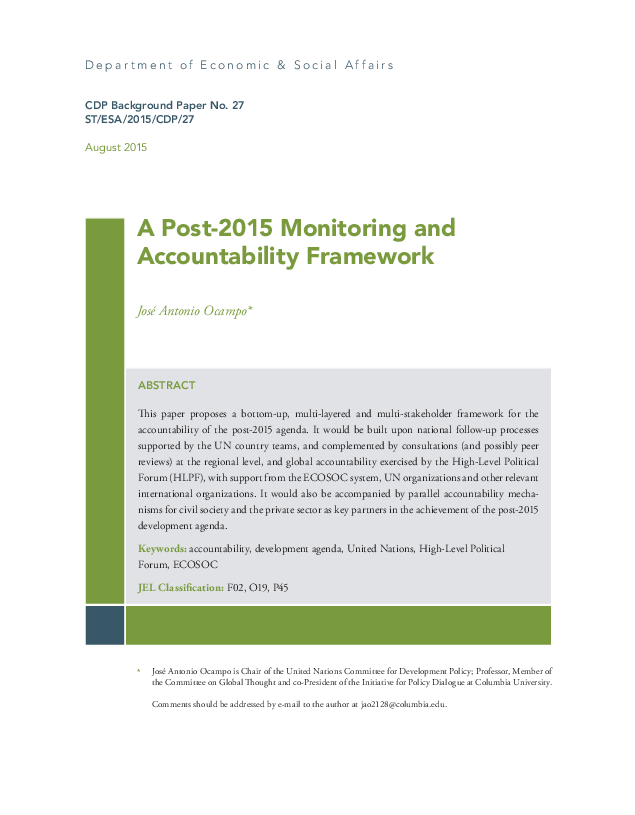
This paper proposes a bottom-up, multi-layered and multi-stakeholder framework for the accountability of the post-2015 agenda. It would be built upon national follow-up processes supported by the UN country teams, and complemented by consultations (and possibly peer reviews) at the regional level, and global accountability exercised by the High-Level Political Forum (HLPF), with support from the ECOSOC system, UN organizations and other relevant international organizations. It would also be accompanied by parallel accountability mechanisms for civil society and the private sector as key partners in the achievement of the post-2015 development agenda.