Displaying 21 - 30 of 60
The paper examines whether the planned eradication of poverty to the year 2030 part of the SDG strategy is compatible with the expected trends in key economic variables such as GDP growth, population growth, income inequality and food prices.
This paper presents some of the challenges of the leaving no-one behind mandate. Firstly, how the development cooperation system can be brought up to date; secondly, why cooperation may still be useful and effective in supporting an Agenda beyond ODA; and finally, the way in which resources should be allocated in order to preserve the purpose of development cooperation.
Strengthened intellectual property requirements, government procurement, dispute settlement constrain policy space for implementing universal health coverage. These consequences can have particularly dramatic effects for countries that made effective use of medicines and intellectual property policies to expand access to medicines.
Least developed countries (LDCs) are characterized by limited productive capacities, which constrains their efforts towards structural transformation and sustainable development. At the same time, the actual policy choices countries that have graduated or have made significant progress towards graduation from the LDC category provide a wide range of lessons other LDCs and the international community can learn from. Whereas countries can be on different pathways towards graduation, a diverse set of social, macroeconomic, financial, agricultural and industrial policies can be effective. However, good development governance is the key factor for successfully expanding productive capacity.
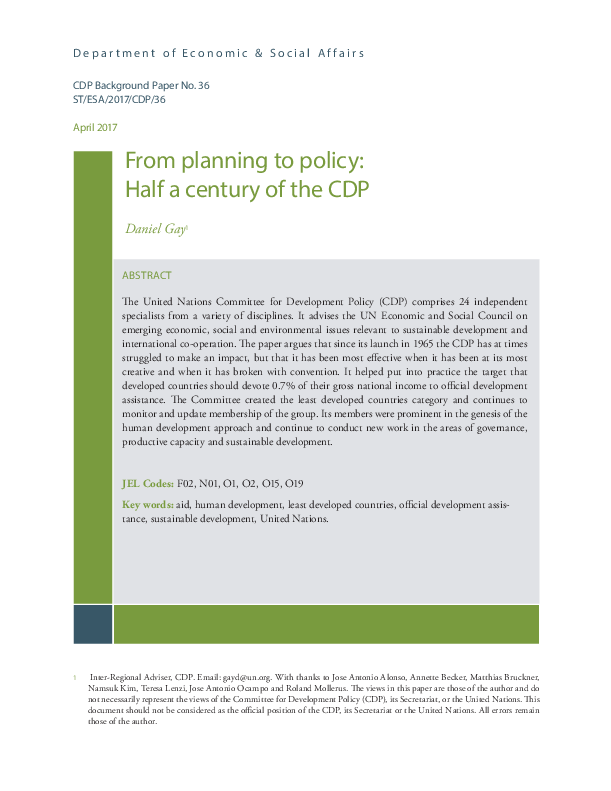
The United Nations Committee for Development Policy (CDP) comprises 24 independent specialists from a variety of disciplines. It advises the UN Economic and Social Council on emerging economic, social and environmental issues relevant to sustainable development and international co-operation. The paper argues that since its launch in 1965 the CDP has at times struggled to make an impact, but that it has been most effective when it has been at its most creative and when it has broken with convention.
The CDP helped put into practice the target that developed countries should devote 0.7% of their gross national income to official development assistance. The Committee created the least…
This paper analyzes opportunities for growth in Nepal by applying the policy tool of New Structural Economics ? Growth Identification and Facilitation Framework (GIFF). Drawing on firm level surveys, stakeholder interviews, and existing datasets it aims to contribute to policy discussions in Nepal and to demonstrate the use of the GIFF for other least developed countries. The report argues that Nepal should seek to capture industrial transfer from China to establish a foothold in global value chains, create employment and catalyze structural transformation. The report identifies product-level advantages arising from preferential market access and sector-specific binding constraints, and…
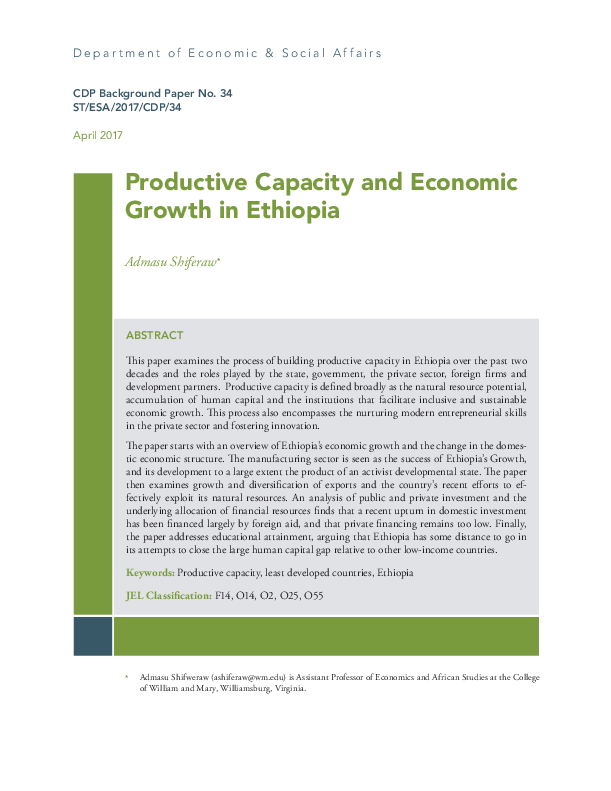
This paper examines the process of building productive capacity in Ethiopia over the past two decades and the roles played by the state, government, the private sector, foreign firms and development partners. Productive capacity is defined broadly as the natural resource potential, accumulation of human capital and the institutions that facilitate inclusive and sustainable economic growth. This process also encompasses the nurturing modern entrepreneurial skills in the private sector and fostering innovation. The paper starts with an overview of Ethiopia's economic growth and the change in the domestic economic structure. The manufacturing sector is seen as the success of Ethiopia's Growth…
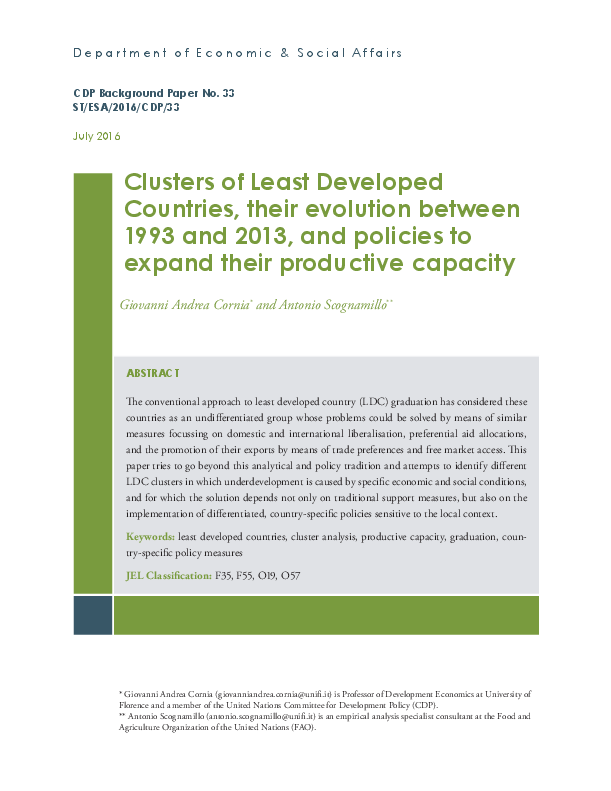
The conventional approach to least developed country (LDC) graduation has considered these countries as an undifferentiated group whose problems could be solved by means of similar measures focusing on domestic and international liberalisation, preferential aid allocations, and the promotion of their exports by means of trade preferences and free market access. This paper tries to go beyond this analytical and policy tradition and attempts to identify different LDC clusters in which underdevelopment is caused by specific economic and social conditions, and for which the solution depends not only on traditional support measures, but also on the implementation of differentiated, country-…
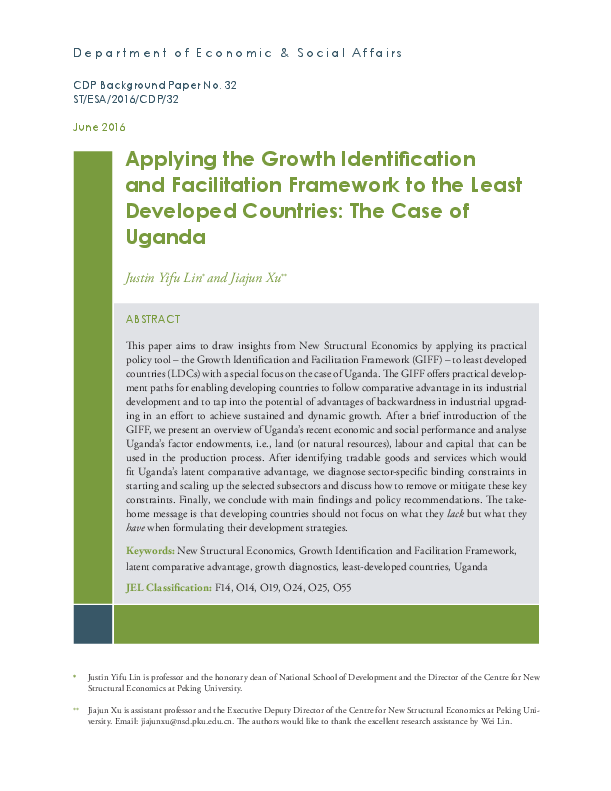
This paper aims to draw insights from New Structural Economics by applying its practical policy tool - the Growth Identification and Facilitation Framework (GIFF) - to least developed countries (LDCs) with a special focus on the case of Uganda. The GIFF offers practical development paths for enabling developing countries to follow comparative advantage in its industrial development and to tap into the potential of advantages of backwardness in industrial upgrading in an effort to achieve sustained and dynamic growth. After a brief introduction of the GIFF, we present an overview of Uganda's recent economic and social performance and analyse Uganda's factor endowments, i.e., land (or…
Economic growth, environmental sustainability and human development in the Solomon Islands have lagged much of the Pacific region since independence in 1978. Trade contributes insufficiently to development, partly because of the dominance of the logging industry but also due to the lack of emphasis on building productive capacities with a view to economic transformation toward higher productivity activities. Targeted soft industrial policies may help address these shortcomings, in the form of sectoral prioritisation; linkages policies; joint government-donor support to build appropriate infrastructure; and the development of human resources in specific areas. Government institutional…