Displaying 1 - 10 of 59
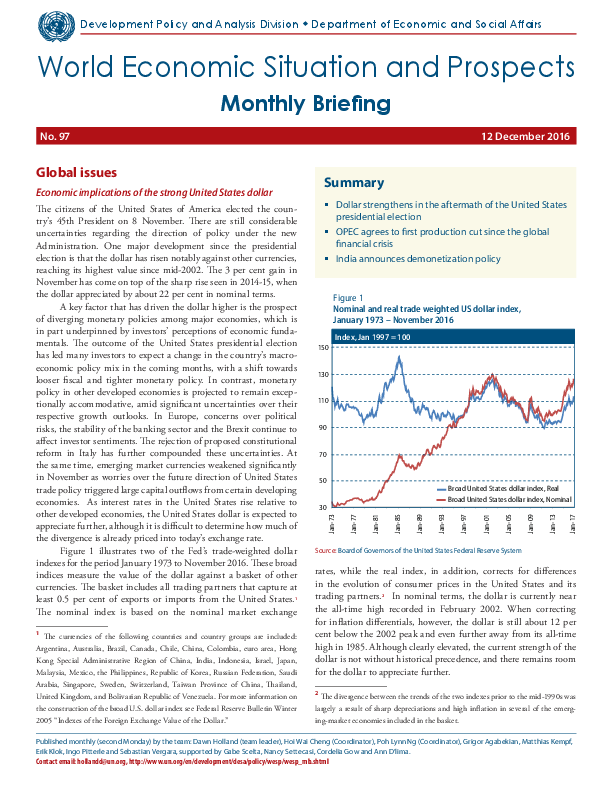
Dollar strengthens in the aftermath of the United States presidential election
OPEC agrees to first production cut since the global financial crisis
India announces demonetization policy
On 2 December 2016 the Secretariat of the Committee for Development Policy (CDP) is organizing an expert group consultation in Geneva to explain the concept behind the LDC graduation toolkit; solicit feedback and establish possible partnerships.
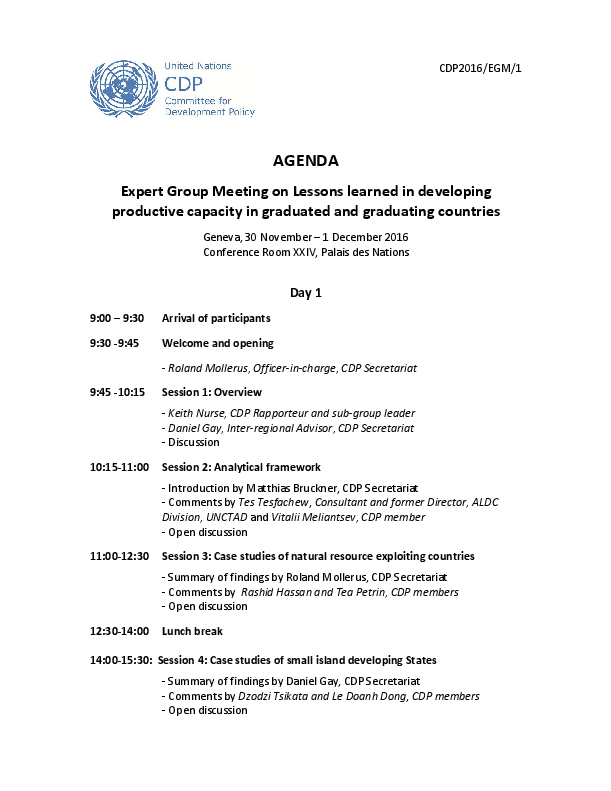
From 30 November to 1 December 2016 the Secretariat of the Committee for Development Policy (CDP) is organizing an expert group meeting (EGM) in Geneva to discuss lessons learned by selected least developed countries (LDCs) and developing countries i
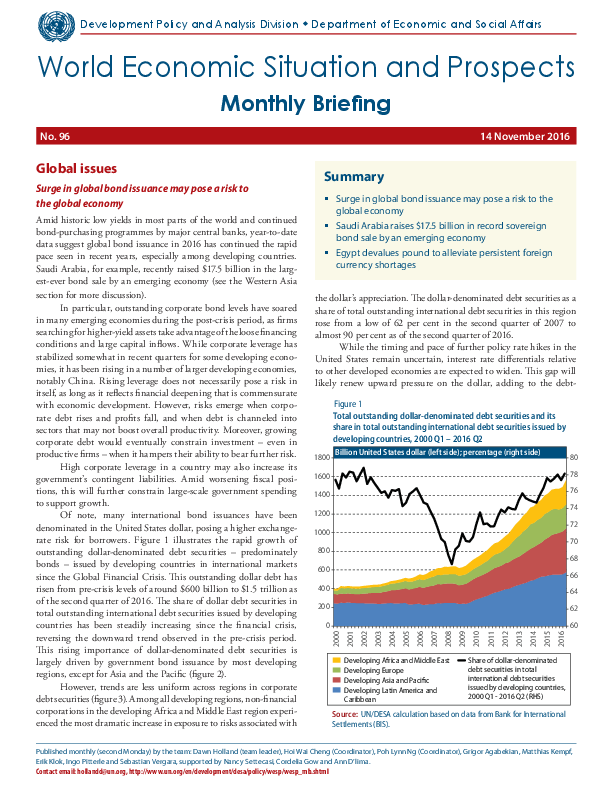
Surge in global bond issuance may pose a risk to the global economy
Saudi Arabia raises $17.5 billion in record sovereign bond sale by an emerging economy
Egypt devalues pound to alleviate persistent foreign currency shortages

The ePing system, an SPS and TBT notification alert system developed by UN DESA in cooperation with the WTO and ITC, is officially launched on 8 November 2016 at the WTO, by UN Assistant Secretary-General for Economic Development in UN DESA Lenni Montiel, WTO Deputy Director General Karl Brauner and the Executive Director of ITC Arancha Gonz?lez.
From 24 to 27 October 2016, an UN expert team, comprising of the CDP, UNDP, UNCTAD and OHRLLS, conducted a joint mission in Luanda, Angola, to provide support to the Government of Angola on the graduation from the LDC category. The UN team held consu
Government policymakers from 16 least developed countries (LDCs) and one graduate, Samoa, will gather in Beijing, China, from 10 to 12 November 2016 to discuss strategies needed to successfully graduate from LDC status and to achieve the Sustainable
The paper reviews the provisions within the WTO multilateral trade regime which impact on the policy space for LDCs which are interested in pursuing industrial policies as latecomers. It finds that LDCs are more constrained by lack of capacity rather than by WTO provisions, in contrast to more advanced developing countries.
The paper investigates the effectiveness of trade preferences for LDCs. It confirms that overall trade preferences for LDCs increase LDC exports. However, it also finds that effectiveness differs across the nine providers included in the study (EU, US, Canada, Japan, Australia, New Zealand, Norway, the Russian Federation and Turkey) and that only a subset of LDCs is able to benefit from trade preferences.
The paper overviews the evidence of good governance institutional reform agenda on the development outcomes of LDCs. For building development governance capacity in LDC for achieving sustainable development goals, successful examples suggest a few key common features: (1) existence of government/political leadership; (2) organizational set up for achieving national development goals; (3) structural transformation from poor human capital base and low quality of the bureaucracies. The lessons learned from these examples cannot simply be transmitted to other LDCs, but should be seen as practical policy lessons.