Publications

Displaying 361 - 370 of 1087
Voluntary national reviews (VNRs), are an important innovation as a United Nations process for follow up to the adoption of development agendas. The paper analyses how countries addressed three key cross-cutting issues of the 2030 Agenda for Sustainable Development in the VNRs submitted in 2017: leaving no one behind; addressing trade-offs through policy integration; and pursuing global partnership as means of implementation. While the VNRs contain already many interesting examples as basis for mutual learning and sharing of, the paper also identifies a need for more attention to these issues and more explicit discussions on strategies for their implementation.
We examine globalization's effects on those left behind in both industrial and emerging markets. While access to global markets has lifted billions out of poverty in emerging markets, the benefits have not been equally shared. Increased competition through globalization as well as skill-biased technical change has hurt less educated workers in rich and poor countries. While much of the rising inequality is often attributed to globalization alone, a brief review of the literature suggests that labor-saving technology has likely played an even more important role. The backlash has focused on the negative consequences of globalization in developed countries, and now threatens the global…
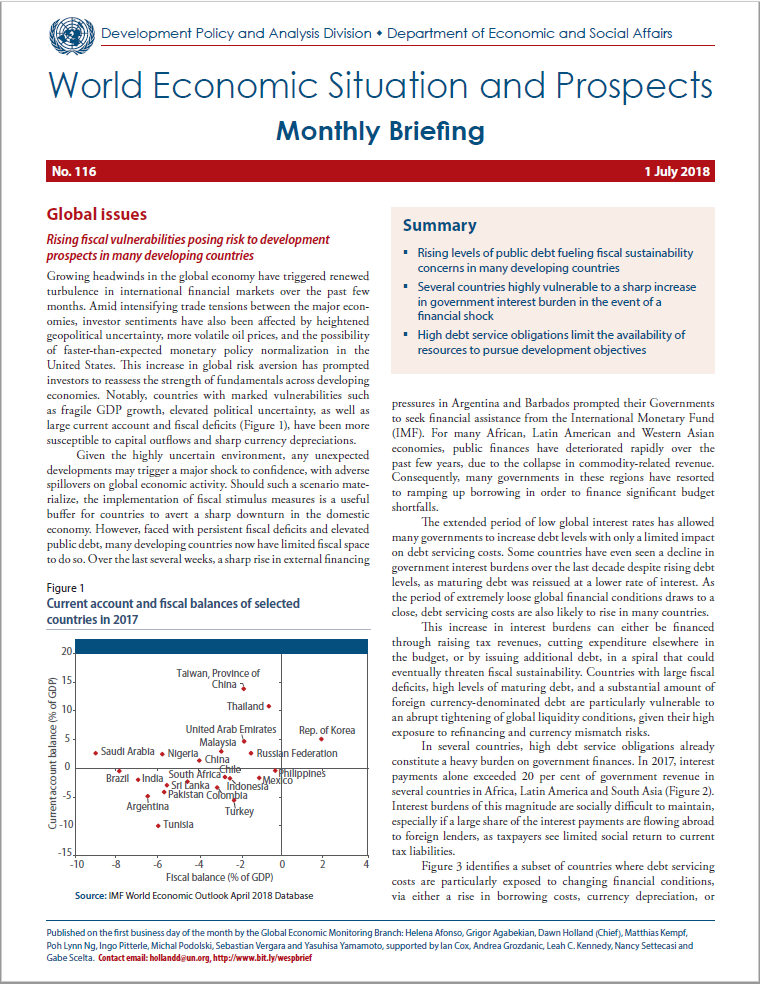
Rising levels of public debt fueling fiscal sustainability concerns in many developing countries
Several countries highly vulnerable to a sharp increase in government interest burden in the event of a financial shock
High debt service obligations limit the availability of resources to pursue development objectives
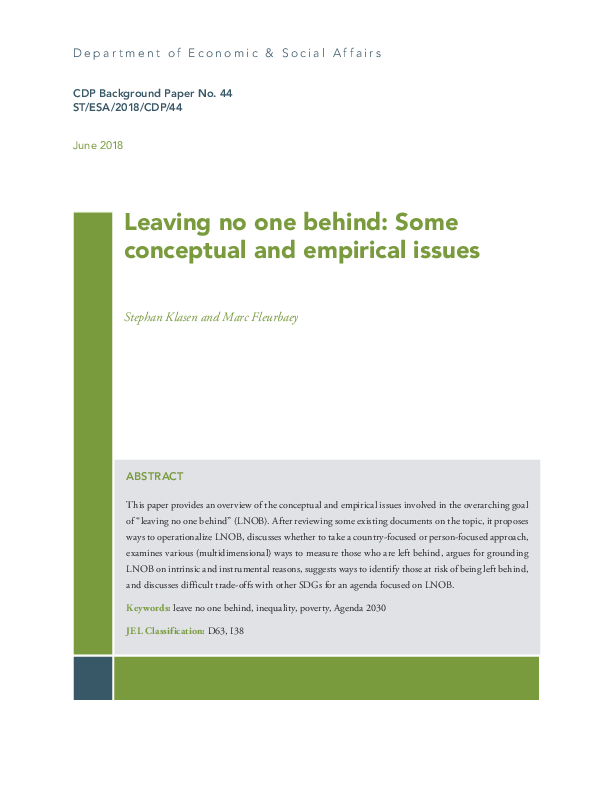
This paper provides an overview of the conceptual and empirical issues involved in the overarching goal of "leaving no one behind" (LNOB). It proposes ways to operationalize LNOB, discusses whether to take a country-focused or person-focused approach, examines various (multidimensional) ways to measure those who are left behind, argues for grounding LNOB on intrinsic and instrumental reasons, suggests ways to identify those at risk of being left behind, and discusses difficult trade-offs with other SDGs for an agenda focused on LNOB.
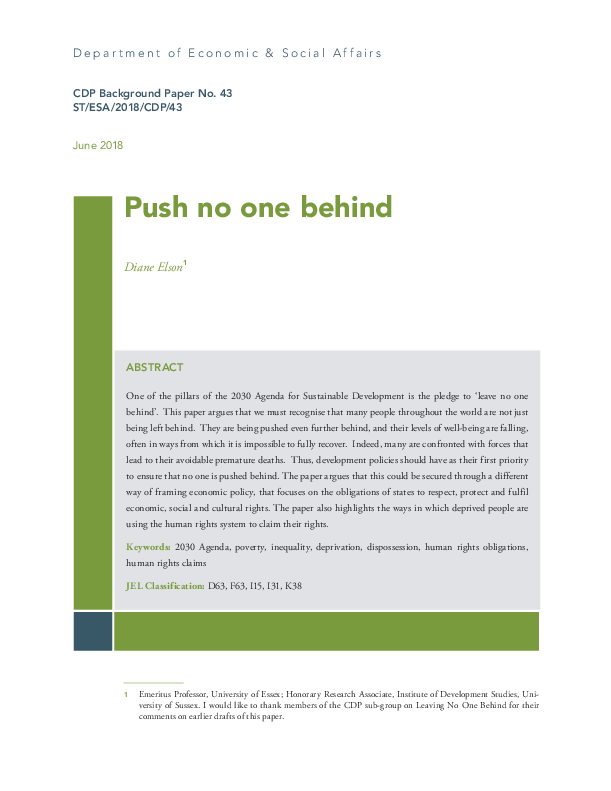
One of the pillars of the 2030 Agenda for Sustainable Development is the pledge to ?leave no one behind?. This paper argues that we must recognise that many people throughout the world are not just being left behind. They are being pushed even further behind, and their levels of well-being are falling, often in ways from which it is impossible to fully recover.
Committee for Development Policy,?Report on the twentieth session? (12-16 March 2018) (E/2018/33)
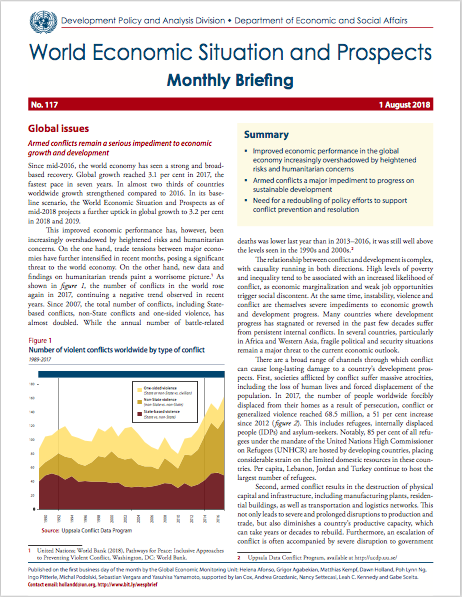
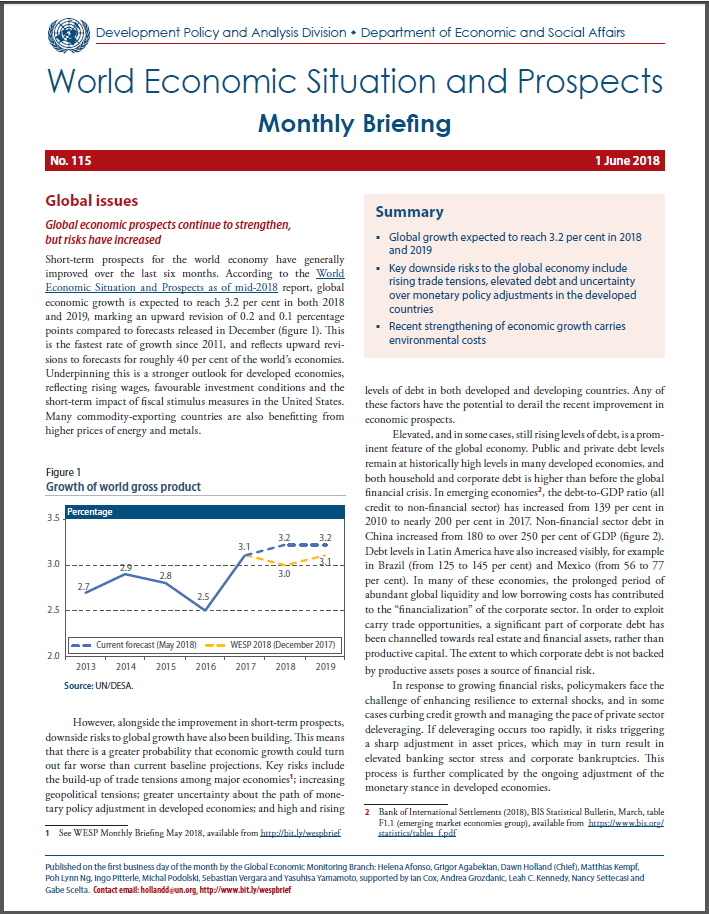
Global growth expected to reach 3.2 per cent in 2018 and 2019
Key downside risks to the global economy include rising trade tensions, elevated debt and uncertainty over monetary policy adjustments in the developed countries
Recent strengthening of economic growth carries environmental costs
The UN Resolution heralding the Sustainable Development Goals pledges to leave no one behind, and moreover "to reach the furthest behind first". This priority echoes the priority to the worst-off that is being discussed in philosophy, economics and related disciplines, but also the pleas of many actors who represent or fight for the most disadvantaged populations. This paper argues that serious theories do support such a priority and that the best policies implementing this priority do not necessarily involve the most intuitive anti-poverty targeted measures.
Short-term prospects for the world economy have continued to improve, according to the World Economic Situation and Prospects as of mid-2018. World gross product is expected to expand by 3.2 per cent in both 2018 and 2019, marking an upward revision from forecasts released in December 2017.
The paper focuses on two crucial issues that hinder the fiscal sovereignty of developing countries: the reduced level of international tax cooperation, and the lack of appropriate procedures for sovereign debt crisis resolution. The low level of international tax cooperation enables a race to the bottom in tax rates among countries, tax avoidance through profit-shifting activities by companies and tax evasion by individuals and companies, based on the existence of non-cooperative jurisdictions.