Publications

Displaying 581 - 590 of 1087
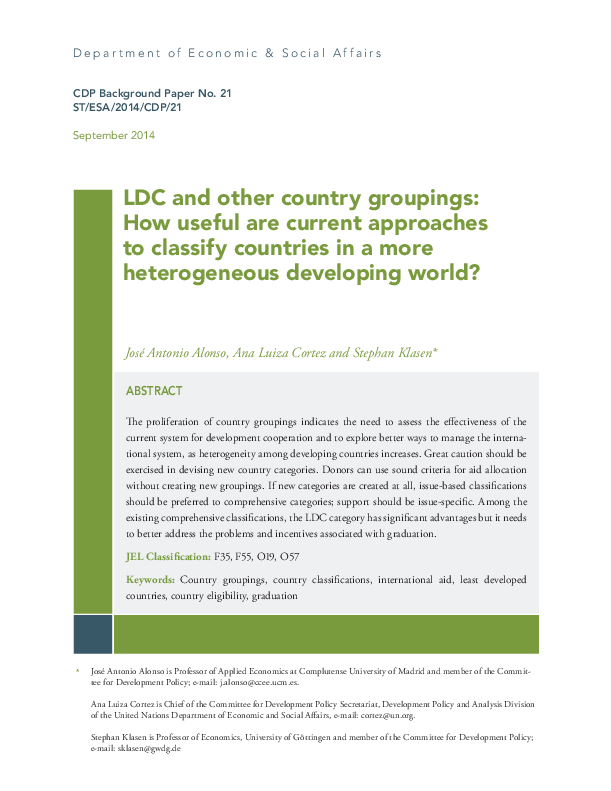
The proliferation of country groupings indicates the need to assess the effectiveness of the current system for development cooperation and to explore better ways to manage the international system, as heterogeneity among developing countries increases. Great caution should be exercised in devising new country categories. Donors can use sound criteria for aid allocation without creating new groupings. If new categories are created at all, issue-based classifications should be preferred to comprehensive categories; support should be issue-specific. Among the existing comprehensive classifications, the LDC category has significant advantages but it needs to better address the problems and…
This paper examines the prospects of achieving a main goal of the Istanbul Programme of Action - at least half of the LDCs to meet the graduation criteria by 2020. Based on two different sets of graduation criteria established by the CDP and current trends in socio-economic indicators of LDCs, the paper concludes that the goal is unlikely to be met even under an optimistic scenario. There are considerable uncertainties about the possible outcome, partly owing to the way in which the graduation criteria are established and partly owing to the difficulty of predicting future course of socio-economic development of LDCs.
Multilateral trade rules have maintained stable and predictable trade flows. Developing countries increased their participation in world markets but marked asymmetries persist; not all countries are benefitting from trade. Successive trade rounds and numerous regional trade and bilateral investment agreements led to significant loss of policy space and fragmentation. Special and differential treatment has not provided necessary flexibility for implementation of development policies while the principle of less than full reciprocity is eroded. Stronger multilateralism, effective overseeing and enforcing role by WTO and greater focus by developing countries in negotiating flexible rules (…
August 2014
Summary: Global equity markets face potential policy shocks
?BRICS announce the creation of the?New Development Bank
?Argentina defaults on its sovereign debt Extr

The role of selected policy instruments in reducing income inequality Giovanni Andrea Cornia
Accelerating progress towards the Millennium Development Goals: options for sustained and inclusive growth and issues for advancing the United Nations development agenda beyond 2015 (A/69/201)
July 2014
Summary: World trade continues sluggish recovery
?Oil prices soar amid political instability in Iraq
Disappointing first quarter for developed economies Despite expectations
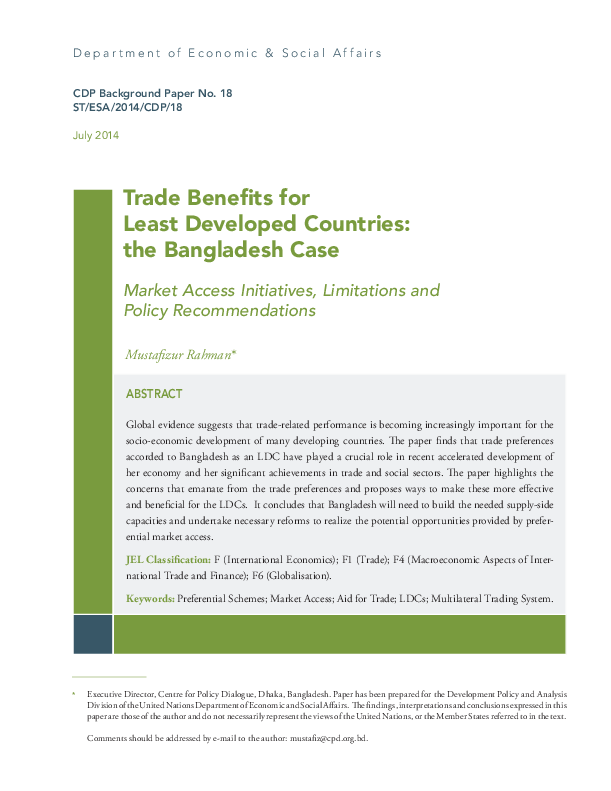
Global evidence suggests that trade-related performance is becoming increasingly important for the socio-economic development of many developing countries. The paper finds that trade preferences accorded to Bangladesh as an LDC have played a crucial role in recent accelerated development of her economy and her significant achievements in trade and social sectors. The paper highlights the concerns that emanate from the trade preferences and proposes ways to make these more effective and beneficial for the LDCs. It concludes that Bangladesh will need to build the needed supply-side capacities and undertake necessary reforms to realize the potential opportunities provided by preferential…